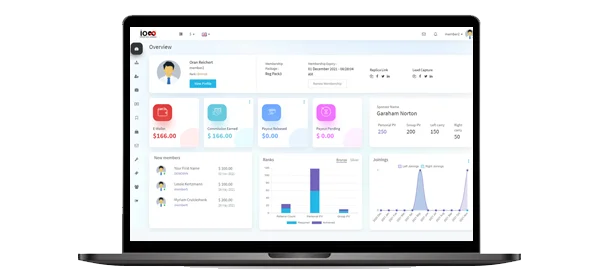

Australian Binary Plan MLM Software: What is it & How It Works


The Australian Binary Plan sounds straightforward on paper: two legs, a third leg, and no pair-matching required. But the moment you try to run it on generic MLM software, the complexity hits fast. Commission calculations break. Genealogy trees do not render correctly. Payouts have to be processed manually. The plan itself is not the problem. The software is. Here is how to get both right.
The Australian binary MLM plan is a compensation structure derived from the traditional binary MLM model, enhanced by the introduction of a third leg.
In a standard binary system, distributors build two legs: left and right, where commissions are generated through matched volume between these legs. The Australian binary model removes this dependency.
Instead, it allows distributors to build a third leg, where volume contributes to commissions without requiring a corresponding match on the opposite side.
The fundamental distinction lies in how commissions are calculated, which directly impacts earning potential and network growth flexibility.
In a traditional binary plan, commissions are triggered only when there is balanced volume between the left and right legs. This means distributors must maintain equal growth on both sides to maximize earnings, often leading to unused or “flushed” volume when one leg outperforms the other.
In contrast, the Australian binary plan calculates commissions based on the total volume generated across all three legs. There is no dependency on matching volume, allowing distributors to earn from overall network performance without being limited by structural balance requirements.
Although the name suggests regional origins, the Australian Binary Plan is not limited to a specific geography. It is widely understood to have emerged as an evolution of the traditional binary structure, designed to overcome the limitations of pair-matching.
Its adoption has expanded globally due to its flexibility, scalability, and ability to support high-growth networks without restricting earnings through strict leg balancing. As MLM businesses began seeking more adaptable compensation models, this structure gained traction as a practical alternative to conventional binary systems.
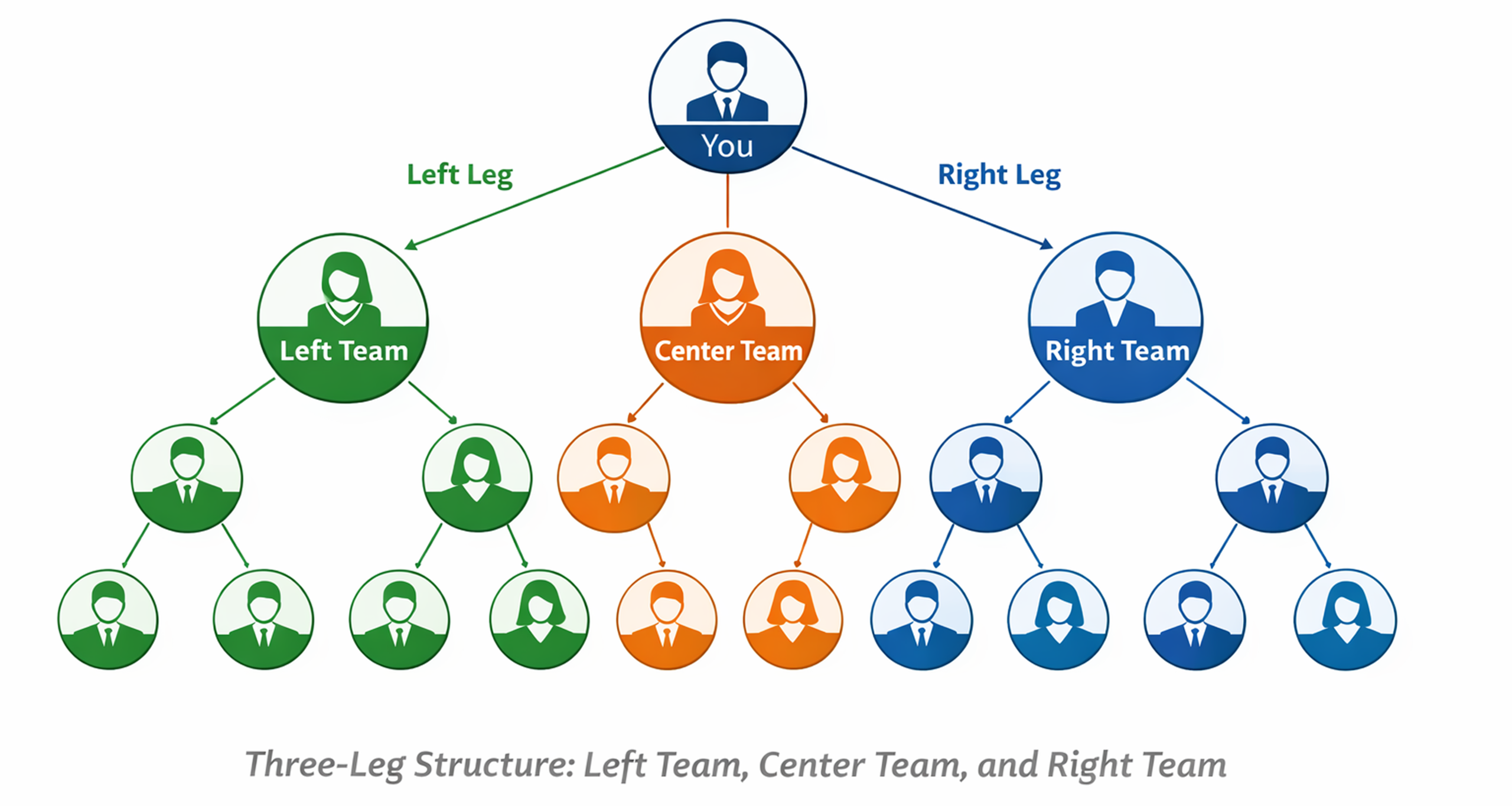
The Australian binary plan operates on a three-leg structure, with commissions calculated based on total business volume (BV).
A distributor begins by building a left leg and a right leg. Once those are in place, a third leg is added to the structure, giving the network its defining multi-leg configuration.
The third leg does not require a matching counterpart. Volume generated here directly contributes to earnings.
Each leg generates business volume:
Example
Volume from the third leg contributes to upline earnings without balance requirements.
While these compensation models may appear structurally similar, the key difference lies in how commissions are calculated and triggered. Understanding these distinctions is essential when selecting the right plan for your business model.
In this model, distributors earn only when both legs generate equal or matching business volume, which can limit earnings if one leg significantly outperforms the other.
Although an additional leg is introduced, the requirement for matching volume remains. This adds complexity without fully eliminating the limitations associated with balance-dependent earnings.
This model removes the dependency on matching volume, allowing distributors to earn based on the overall performance of all three legs, making it more flexible and scalable.
Most MLM platforms are designed around traditional binary logic, which creates significant limitations when applied to the Australian binary structure. Since this model introduces a third leg and removes pair-matching dependency, standard systems often struggle to execute it accurately.
To understand where these systems fall short, it is important to examine the most common limitations that arise when standard software is used for this model.
When standard MLM software is used to run an Australian Binary Plan, several critical gaps begin to appear, affecting both operational efficiency and payout accuracy:
Standard MLM systems are built to validate commissions based on matched volume between two legs. When this requirement is removed, as in the Australian binary plan, the system may fail to process commissions correctly.
Without a commission engine designed for three-leg structures, volume generated in the third leg may be ignored, partially calculated, or incorrectly distributed, leading to payout inconsistencies.
Most platforms are designed to display a two-leg hierarchy. This makes it difficult to accurately represent and track a three-leg network structure, reducing clarity for both administrators and distributors.
Due to system limitations, businesses often rely on manual calculations or external tools to correct commission errors, increasing operational effort and the risk of inaccuracies.
Tracking and processing volume across three independent legs requires a more advanced system architecture. Standard software may struggle to deliver real-time updates, impacting transparency and decision-making.
The software must be purpose-built for this structure. Since the Australian binary model operates on a three-leg system with volume-based commissions, it requires capabilities that go beyond standard MLM functionality. To ensure accurate execution, scalability, and transparency, the following features are essential:
Standard commission engines are built on pair-matching logic that the Australian Binary Plan does not use.
The software must:
Generic MLM software defaults to a two-column binary tree view, which does not fit this model.
The software must:
Commissions are driven by combined leg performance, not pair balance, making visibility critical.
The software must:
The Australian Binary Plan varies across companies with different commission structures and payout rules.
The software must:
Rank progression depends on combined performance across all three legs.
The software must:
With three legs generating commissions simultaneously, manual payout processing is not scalable.
The software must:
Income reporting is more complex in a three-leg system due to multiple earning sources.
The software must:
This model supports multiple earning layers, allowing distributors to generate income from both personal efforts and overall network performance.
The Australian Binary Plan incorporates multiple bonus types to create diverse earning opportunities. Each bonus is designed to reward specific distributor activities and overall network performance.
Together, these bonuses create a balanced compensation system that rewards both individual effort and team success. This multi-layered structure enhances earning potential while supporting long-term network growth.
Capping mechanisms are implemented to maintain financial stability and ensure controlled commission payouts. They help businesses manage liabilities while keeping the compensation plan sustainable.
These limits provide a structured approach to managing payouts without compromising distributor motivation. When configured effectively, they ensure both profitability and long-term operational consistency.
A structured evaluation prevents costly mistakes. Selecting the right software is critical, as the Australian binary model requires precise handling of three-leg structures, volume-based calculations, and real-time processing.
To ensure the platform meets both current and future business needs, the following criteria should be carefully evaluated:
The system must natively support three independent legs and calculate commissions based on total volume, without relying on traditional pair-matching logic.
A clear and dynamic view of all three legs is essential, with real-time updates that allow both administrators and distributors to track network growth and placement.
The software should allow easy customization of commission structures & bonuses, and payout rules to adapt to changing business strategies.
Enables smooth global operations by supporting transactions, commission payouts, and reporting in multiple currencies.
Provides comprehensive insights into business volume, earnings, and distributor performance, helping in better decision-making and transparency.
Working with providers who have prior experience in Australian binary implementations reduces the risk of errors and ensures smoother deployment.
A live demo allows businesses to validate system functionality, user experience, and real-time capabilities before finalizing the solution.
This plan is best suited for businesses that require scalability, flexibility, and the ability to manage high-volume distributor networks efficiently. However, its effectiveness depends on the stage of the business, network size, and operational readiness.
To determine the right fit, it is important to evaluate where the Australian Binary Plan performs best and where it may introduce complexity:
Advanced software capability for proper execution: The success of the Australian Binary Plan depends on MLM software that can accurately handle three-leg structures, volume-based commissions, and real-time processing without manual intervention
The Australian Binary Plan offers significant flexibility and scalability, but its success depends on precise execution. That execution is only possible with software designed specifically for its structure.
For businesses evaluating this model, selecting the right platform is as important as choosing the compensation plan itself. A generic binary platform will not handle three-leg genealogy, third-leg commission logic, or configurable payout rules accurately. Investing in purpose-built software from the start removes the operational friction that causes most Australian Binary Plan implementations to underperform.
If you are still comparing plans, take the time to validate your software choice before committing. The plan works. The question is whether your platform can execute it.
The Australian Binary Plan is a three-leg compensation model that allows distributors to earn commissions based on total business volume across all legs. It is an evolution of the traditional binary plan, offering greater flexibility and scalability for large networks.
Unlike the standard binary plan, which requires balanced volume between two legs to trigger commissions, the Australian Binary Plan calculates earnings from all three legs, removing strict pair-matching requirements and enabling more flexible payouts.
No. Commissions are based on the total volume generated across all three legs, which means distributors can earn without waiting for balanced placement on opposing legs.
The third leg contributes additional business volume, which increases upline earnings without the need for balance. It is the key differentiator that allows distributors and uplines to benefit more from network growth.
Most standard MLM platforms are designed around two-leg pair-matching logic. Without specialized functionality, they may fail to calculate commissions accurately, display three-leg genealogy correctly, or process payouts automatically.
The plan typically includes third-leg bonuses, rank advancement bonuses, sponsor/referral bonuses, and sometimes matching bonuses from downline commissions. Each bonus layer rewards different types of distributor activity and overall network performance.
It is generally better suited for established MLM businesses with larger networks. Smaller or early-stage businesses may find managing three legs complex and may benefit more from simpler binary models until their network grows.
Commissions are based on total business volume across all three legs. This volume is processed through the software’s dedicated commission engine to ensure accuracy, proper rank advancement, and timely payouts.
Yes. With the right software, the Australian Binary Plan can handle multi-currency transactions, international payouts, and real-time tracking, making it scalable for businesses operating in multiple regions.
The key is using MLM software specifically designed for the Australian Binary Plan. It must handle three-leg structures, real-time commission calculations, and automated payouts, ensuring accuracy and reducing operational complexity.
Product Specialist & Research Head

Are you on the lookout for a cost-effective software solution with advanced features for your MLM business? Infinite MLM software might just be the thing for you.
Connect with Us