
MLM Software for NFT Communities and Digital Asset Communities: Structuring Commissions

NFT ecosystems are evolving fast, but when it comes to referral commissions, most operators face a fundamental problem. Traditional systems lack the capabilities of advanced MLM software needed for blockchain-based assets.
From fluctuating NFT prices to gas fees and wallet-based identities, structuring commissions requires a completely different approach, this guide breaks it down step by step.
NFT-based commissions introduce complexities that don’t exist in traditional MLM systems. Unlike conventional products, NFTs operate within a decentralized and market-driven ecosystem, which directly impacts how commissions and bonuses are calculated, tracked, and distributed.
Traditional MLM products follow a fixed pricing model, where each product has a predefined cost. This makes commission calculations straightforward, percentages are applied to a constant value, ensuring predictable earnings for distributors. It also simplifies volume tracking, rank qualifications, and bonus calculations within the system.
NFTs function in a variable pricing environment, where asset values fluctuate based on demand, rarity, utility, and market trends. As a result, commission calculations must be dynamic, adjusting in real time to the actual transaction value. This adds complexity to the system, requiring advanced software that can capture live pricing data, calculate accurate commissions instantly, and maintain consistency across different types of transactions.
NFT ecosystems introduce multiple earning moments, unlike traditional MLM models that typically focus on a single product sale. Each event requires distinct commission logic within the software.
These commissions are earned when an NFT is minted or sold for the first time. This is the initial transaction where referral rewards are distributed based on the buyer’s network. It usually forms the core earning opportunity and is often structured across multiple levels in the referral chain.
These are triggered when NFTs are resold on marketplaces. Since NFTs can be traded multiple times, this creates ongoing earning potential. Commission systems must integrate with marketplace transactions to track resales and allocate rewards accurately without interfering with built-in royalty mechanisms.
These commissions apply when users reinvest in the ecosystem, such as upgrading to higher-tier NFTs or purchasing additional assets. Unlike resale commissions, these are typically structured as fresh transactions, allowing platforms to incentivize continued engagement and long-term participation.
In NFT ecosystems, royalties and referral commissions are often confused, but they serve completely different purposes and must be handled separately within the system.
Modern NFT development solutions are designed to manage both mechanisms independently to ensure accurate reward distribution, transparent transactions, and better platform governance.
Creator royalties are built directly into the NFT smart contract and are automatically distributed to the original creator whenever the NFT is sold, especially in secondary market transactions. This ensures that creators continue to earn from the ongoing trading of their assets without relying on external systems.
Referral commissions are distributed to users within the network based on their role in bringing new buyers or participants into the ecosystem. Unlike royalties, these are not enforced at the token level and must be managed by MLM software, which tracks referral relationships and calculates payouts accordingly.
Traditional MLM systems are not designed to handle blockchain-based transactions, which leads to major limitations when applied to NFT environments.
Conventional MLM software operates in centralized environments and cannot directly interact with blockchain networks. As a result, it cannot track on-chain NFT transactions, verify wallet activity, or ensure transparency in commission distribution.
Most traditional systems are built for fixed-price products and struggle to adapt to fluctuating NFT values. Without real-time pricing integration, commission software calculations become inaccurate, leading to inconsistencies in payouts and reporting.
Upgrade to advanced MLM software designed for blockchain-based assets and eliminate errors, delays, and manual tracking.
NFT communities leverage referral systems in different ways depending on their purpose, MLM business model, and user engagement strategy. Unlike traditional MLM setups, these ecosystems are more flexible, allowing referral structures to adapt to various digital asset use cases.
In NFT marketplaces, referral systems are used to drive both buyer acquisition and creator participation. Users earn commissions by bringing in new buyers or collectors, while creators benefit from increased visibility and sales. This creates a balanced growth loop where both sides of the marketplace expand organically through network-driven incentives.
Membership-based NFT platforms use referral systems to grow exclusive communities. Users earn rewards by onboarding new members who purchase access NFTs, such as passes for premium content, private groups, or specialized services. This approach not only drives growth but also strengthens community engagement by aligning incentives with participation.
Gamified elements and DeFi ecosystems integrate MLM-style referral structures to encourage both recruitment and ongoing activity. In play-to-earn models, users are rewarded for bringing in active participants, often forming network-based communities or guilds. In DeFi platforms, referrals are tied to performance, where users earn a share of transaction fees or yield generated by those they introduce, making the system activity-driven rather than one-time reward-based.
Each NFT or digital asset ecosystem has unique requirements, which means the compensation structure must be tailored accordingly. Marketplaces require flexible and continuous commission models, while membership platforms need more controlled and predictable payouts. Aligning the compensation plan with the use case ensures sustainable growth, fair reward distribution, and long-term ecosystem stability.
Choosing the right compensation model is critical for scalability, as it directly impacts how your community grows, engages, and sustains long-term participation.
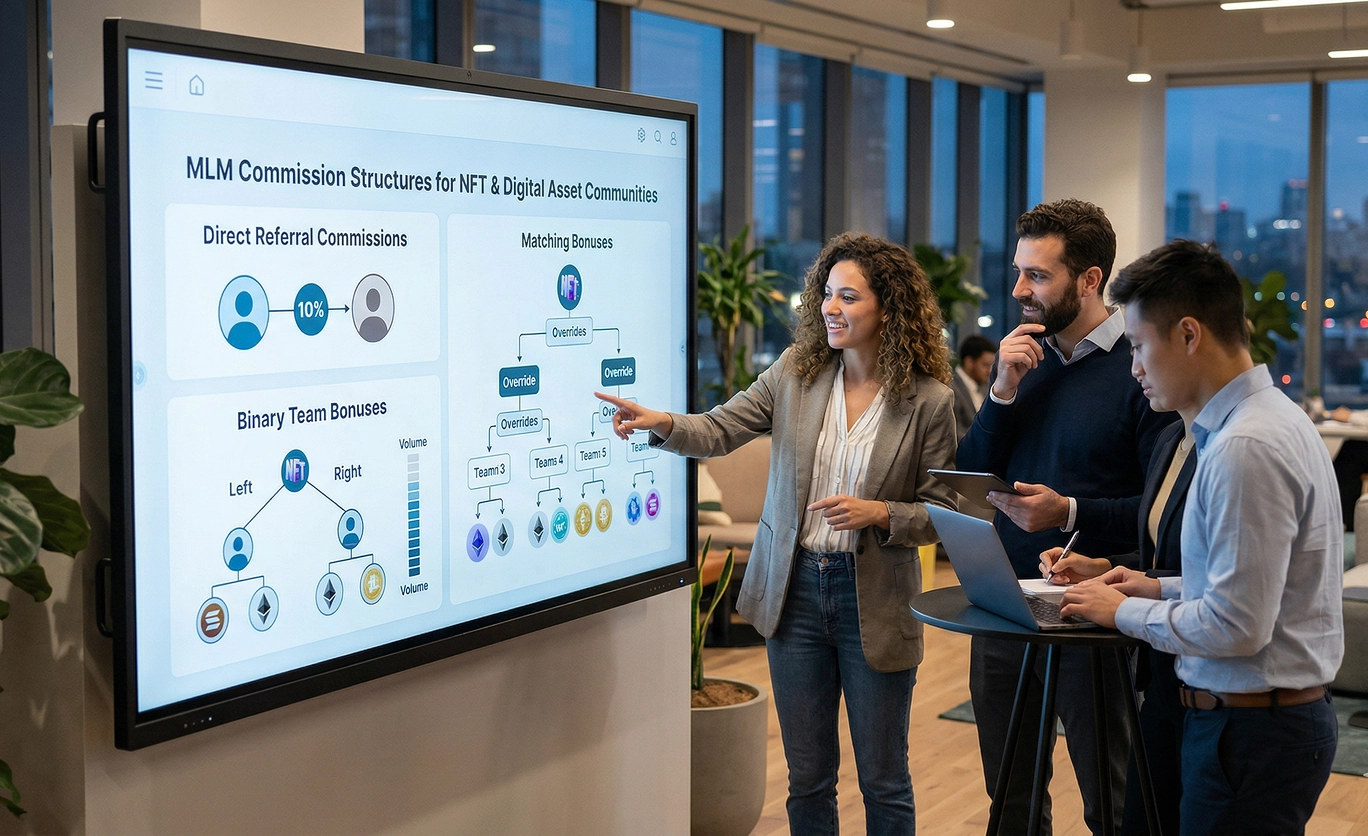
A unilevel plan is best suited for open NFT marketplaces where growth depends on continuous user acquisition. It allows unlimited direct referrals, making it ideal for ecosystems with frequent transactions and ongoing trading activity. This structure supports steady expansion and ensures that participants are rewarded consistently as their network grows over time.
A binary plan works particularly well for NFT launches and drop campaigns where rapid growth is essential. By organizing participants into two legs, it encourages balanced expansion across the network. This structure motivates users to build both sides equally, making it effective for driving momentum during high-demand launch phases.
A matrix plan is designed for controlled and structured growth, making it ideal for membership-based NFT communities. With limited width and depth, it creates spillover benefits that encourage collaboration among participants. This not only improves engagement but also strengthens retention by ensuring that new members receive support from the network.
Hybrid compensation plans are useful when a single structure cannot meet the needs of the ecosystem. By combining elements of unilevel and binary models, they offer both flexibility and performance-driven incentives. This approach is increasingly used in high-value NFT projects where both continuous growth and structured rewards are required.
NFT price fluctuation directly impacts commission calculations, making real-time adjustments essential. Since NFT values can change with every transaction, volume-based metrics like personal volume and rank qualifications must be dynamically calculated. This requires advanced systems that integrate live pricing data to ensure accuracy and fairness in commission distribution.
Modern MLM platforms use auto-smart contracts to automate NFT commissions, ensuring that sales, referrals, and bonuses are calculated and paid instantly. This creates a transparent, error-free, and trustless system without manual intervention.
A smart contract commission engine acts as the backbone of NFT-based MLM operations, handling every aspect of commission logic.
The engine calculates commissions based on predefined compensation plans; binary, matrix, or uni-level and distributes earnings instantly. This removes dependency on admins, eliminates calculation errors, and ensures that every participant receives their rightful share in real time.
Different smart contracts work together to create a fully automated commission ecosystem.
These contracts record wallet relationships and track who referred whom. Every new NFT purchase or user entry is permanently logged on the blockchain, ensuring accurate genealogy tracking.
They calculate and split commissions according to the MLM structure. Whether it’s direct referral bonuses or multi-level earnings, the logic is executed automatically without manual validation.
These contracts handle the final step, transferring earnings directly to user wallets. Once conditions are satisfied, funds are released instantly, ensuring seamless auto payouts.
Choosing the right blockchain is critical for performance, cost, and scalability. Each network presents tradeoffs between decentralization, speed, and cost, so the choice depends on your MLM model and transaction volume.
Highly secure and widely adopted, but gas fees can be expensive.
Offers lower fees and faster transactions, ideal for scalable MLM operations.
Cost-efficient with strong ecosystem support, suitable for high-volume transactions.
Extremely fast with minimal fees, but relatively newer and less decentralized compared to Ethereum.
Gas fees can impact profitability if not handled properly. MLM platforms implement buffer strategies where a small portion of transactions is reserved to cover gas fees. This ensures that users always receive a net positive payout and are not burdened by fluctuating transaction costs. Some systems also use layer-2 solutions or batch transactions to further reduce fees and improve efficiency.
While automation brings efficiency, it also introduces certain limitations.
Once deployed, smart contracts cannot be easily modified. This immutability ensures security but also means that any bugs or flawed logic can be permanent.
To mitigate risks, platforms must:
Web3 transforms user authentication by replacing traditional email/password logins with wallet-based identity. This makes networks more secure, decentralized, and easy to manage.
Onboarding becomes instant with one-click wallet connections using platforms like MetaMask. Users can join without creating accounts, reducing friction and accelerating adoption. Wallets also allow participants to control their digital assets directly, eliminating reliance on centralized systems. This ensures a smoother start for new users and reduces drop-offs during the initial setup process.
Referral networks are constructed using wallet addresses instead of user IDs. Every referral and transaction is recorded on-chain, providing transparency and immutability. Participants can verify their network position and earnings independently. This system prevents data manipulation and builds trust within the community. Wallet-based genealogy also simplifies tracking for platform administrators, creating a reliable, auditable structure.
Multi-wallet abuse is a key risk in decentralized networks. Platforms deploy behavior tracking and pattern detection to monitor referral activity. Suspicious behaviors, like repeated loops or unusual transaction patterns, are flagged automatically. This ensures that only genuine participation receives rewards. By combining automated monitoring with smart contract rules, networks maintain fairness while protecting revenue streams.
NFT values fluctuate rapidly, impacting commissions if not managed properly. Modern MLM software integrates real-time pricing oracles for accurate, immediate calculation. This guarantees fair payouts regardless of market volatility, reduces disputes, and improves user confidence. Platforms that ignore dynamic pricing risk underpaying participants or creating inconsistencies in the network.
NFT MLM systems require handling multiple commission types, including primary sales, secondary market resales, and upgrades. Each event type must have independently configurable rules, ensuring clarity and fairness across all transaction categories. This allows platforms to reward different participant activities without overlapping logic or payout conflicts.
Direct payouts to user wallets, including MetaMask, Trust Wallet, and Ledger, in USDT, ETH, BNB, MATIC, or project tokens simplify the commission process for distributors. Multi-wallet support accommodates users managing multiple identities. This seamless payout mechanism increases adoption and reduces administrative overhead significantly.
Supporting multiple blockchain networks is crucial for scalability and cost efficiency. Networks like Ethereum, Polygon, and BNB Smart Chain provide flexibility. Users can select low-fee transactions and optimize speed. Multi-chain support also ensures compatibility with diverse NFT ecosystems and increases platform reach across communities.
Traditional email-based downline trees do not function in Web3 environments. The genealogy tree must be keyed to wallet addresses rather than email IDs, with referral relationships recorded as on-chain entries. This replaces fragile centralized identity records with a verifiable, tamper-proof network structure.
Distributors need the ability to independently verify their commission transactions on public blockchain explorers such as Etherscan or Polygonscan. Software that integrates explorer links directly into the back office removes the need for distributors to trust platform-reported figures alone, which is a significant trust-building feature for Web3 audiences.
Platforms must maintain a clear separation between ERC-2981 creator royalties and MLM referral commissions in all reporting interfaces. A dedicated royalty tracking dashboard prevents confusion, protects creator rights, and keeps compliance reporting accurate when regulators request income breakdowns.
Rank advancement criteria must be configurable against wallet-verified trading volume thresholds, not just internal platform activity. When a distributor’s downline reaches qualifying on-chain volume across all legs, the rank upgrade should trigger automatically without admin intervention, maintaining consistency and preventing disputes.
An admin-configurable gas fee reserve ensures that distributor net payouts are always positive regardless of current network congestion. Without this feature, high gas fee periods reduce or eliminate distributor earnings on lower-value transactions, which creates support tickets, disputes, and distributor churn. The buffer percentage should be adjustable without code changes.
Automated income disclosure generation flags commission events that may trigger securities review thresholds based on jurisdiction. The module should produce structured income data per distributor, support geographic commission restrictions for prohibited regions, and generate audit-ready records on demand. This is a non-negotiable feature for any NFT MLM platform operating across multiple jurisdictions.
Dual reporting dashboards that separate creator royalties from referral commissions ensure clarity for both creators and participants. Compliance tools like automated income disclosure and geographic restrictions maintain regulatory alignment. Transparent operations build trust and reduce disputes over the long term.
The Howey Test evaluates whether MLM commissions count as securities. Programs focused on new recruitment over product utility face higher scrutiny. Understanding and applying this test ensures the platform stays within legal boundaries. Integrating compliance measures during software design reduces potential regulatory risks.
Safe NFT MLM programs adopt utility-focused models that prioritize product value. Geographic restrictions prevent operations in prohibited regions. Automated income disclosures provide transparency to regulators and participants. These combined measures ensure long-term sustainability and protect users from legal exposure. Platforms that implement these tools maintain credibility and participant trust.
The following is a composite example based on a typical membership NFT community configuration. It illustrates how three distinct commission streams are structured, tracked, and paid using MLM software.
Setup: A 10,000-member NFT collection using a unilevel plan with five active commission levels. The NFT grants access to a private community, exclusive content drops, and member-only trading benefits.
When a new member purchases a mint NFT, a 10% referral commission is distributed across three upline levels: 5% to the direct referrer, 3% to the second-level upline, and 2% to the third-level upline. The software calculates this split automatically at the moment of on-chain purchase confirmation, with no admin input required. All three payouts are queued for the next settlement cycle and visible to each recipient in their dashboard in real time.
When a member resells their NFT on a secondary marketplace, a 2.5% royalty is captured on-chain via the ERC-2981 standard and returned to the platform. Of that 2.5%, 1% is automatically routed to the original referrer who first brought that NFT holder into the ecosystem. The remaining 1.5% is retained by the platform. This routing is handled by a commission distribution contract that identifies the original referral relationship from on-chain genealogy records.
When a member upgrades to a higher-tier NFT package, a flat-rate unilevel commission is applied based on the upgrade package value, not the fluctuating floor price of the NFT. This insulates upline earners from secondary market volatility and makes upgrade commissions predictable and plannable.
After implementing purpose-built MLM software to replace a manual tracking system, the platform recorded the following results within the first six months:
These outcomes reflect the operational difference between a purpose-built NFT MLM platform and a generic referral tracking system adapted for blockchain use.
Complex wallet setups often cause new users to abandon onboarding. Guided tutorials and step-by-step instructions reduce friction and improve completion rates. Platforms that simplify wallet integration enhance adoption and engagement. Early support and education build user confidence. A streamlined onboarding process increases the chances of long-term retention.
The “first commission moment” triggers initial earnings to motivate users. Real-time dashboards provide insights on network activity and performance. Instant notifications alert users to commissions, rank changes, and referrals. Early engagement builds momentum and encourages participants to remain active. Platforms that emphasize early rewards see higher retention rates and network growth.
Manual referral tracking systems become inefficient as networks scale. Migration involves mapping wallet relationships into structured genealogy models. Proxy-based smart contract upgrades allow improvements without losing existing data. Proper migration reduces errors, increases system reliability, and enhances participant trust. Platforms that follow structured migration methods minimize downtime and disruptions.
After migration, thorough validation and testing ensure commission logic functions correctly. Discrepancies are detected early, preventing payout errors. Accurate tracking maintains network integrity and participant confidence. Platforms that prioritize post-migration verification improve long-term system stability and reliability.
NFT and digital asset communities are rewriting how referral networks operate. Variable pricing, wallet-based identity, smart contract automation, and multi-chain payouts are not future considerations. They are the current reality that any operator building a referral program in this space must plan for from day one.
Generic MLM software was not built for this environment. The failure points are predictable: commission calculation errors as NFT prices move, genealogy structures that cannot represent wallet-based networks, payout failures when gas fees are not accounted for, and compliance gaps that become legal exposure as regulatory scrutiny increases. These problems do not appear immediately. They surface as the network scales, and by that point, migration is significantly more complex and costly.
The right software handles all of this natively, not through workarounds. Smart contract commission engines, dynamic pricing integration, on-chain genealogy tracking, and compliance documentation are not optional add-ons for an NFT MLM platform. They are the foundation. Getting the infrastructure right from the beginning is what separates communities that scale from those that stall.
NFT communities demand more than basic referral systems, they require precision, transparency, and scalability. The right MLM software ensures: Accurate commission tracking, Automated payouts, Compliance-ready operations.
No, traditional MLM platforms are not designed for blockchain or wallet-based operations. NFT MLM systems require integration with smart contracts, crypto wallets, and multi-chain networks to track ownership, handle commissions, and distribute payouts automatically. Without these features, traditional software cannot manage NFT transactions or ensure transparent reward distribution.
Royalties are payments made directly to NFT creators for primary sales and secondary market resales. Commissions, on the other hand, reward referrers in the MLM network for bringing in participants or sales. Separating royalties from commissions ensures transparency, protects creators’ rights, and maintains trust in the referral system.
The best blockchain depends on your priorities, transaction speed, cost efficiency, and ecosystem support. Ethereum offers robust security but higher fees, Polygon is faster and cheaper, and BSC provides broad compatibility. Many platforms use multi-chain support to optimize performance and reach more users while minimizing transaction costs.
Fraud prevention in NFT MLM relies on a combination of wallet tracking, behavioral analytics, and smart contract rules. Multi-wallet abuse, repeated referral loops, and suspicious patterns are detected automatically. This ensures legitimate participants receive fair rewards while protecting the network from fraudulent activity.
The legality of NFT MLM programs varies by jurisdiction and depends on structure. Platforms focused on genuine product utility, transparent commissions, and regulatory compliance are less likely to face legal challenges. Over-reliance on recruitment or ambiguous revenue models increases regulatory risk.
NFT values can change quickly, affecting commissions. Modern platforms integrate real-time pricing oracles to calculate payouts accurately at the time of transaction. This ensures participants always receive fair earnings and prevents disputes due to market volatility.
Co-founder and Chief Marketing Officer at iOSS

Are you on the lookout for a cost-effective software solution with advanced features for your MLM business? Infinite MLM software might just be the thing for you.
Connect with Us